LIFE GRAPHiREC is developing and demonstrating innovative processes for recovering graphite from battery-related waste and returning it to battery production. GRAPHiREC aims to reduce Europe’s dependence on imported graphite, lower the environmental impact of battery production and support a more circular and resilient European battery industry.
The project brings together companies, universities and a European industry association to cover the complete value chain: from waste treatment and graphite recovery to material characterisation, post-processing, battery validation, communication and future market deployment.
KEY TARGETS
These figures are project targets, not results already achieved.
02
industrial recycling pilot plants
>90%
target graphite recovery rate
630t
recycled graphite by project completion
~20%
reduction in CO₂ emissions associated with graphite production
up to 30%
replacement of commercial graphite in battery prototypes
1,800t
recycled graphite annually five years after project completion
ON THIS PAGE
01 / THE CHALLENGE
Why recycling
graphite matters.
Graphite is essential to battery anodes — yet much of the graphite in battery waste is not recovered for use in new batteries.
Europe relies heavily on imported graphite. Conventional recycling processes tend to prioritise valuable metals, while graphite can be lost, burned or used as an energy source during treatment.
GRAPHiREC is working to demonstrate that graphite can be recovered, purified and returned to battery manufacturing, supporting European raw-material security and a more circular industry.
Moving beyond metal recovery. Keeping graphite in circulation means extracting more value from each battery waste stream.
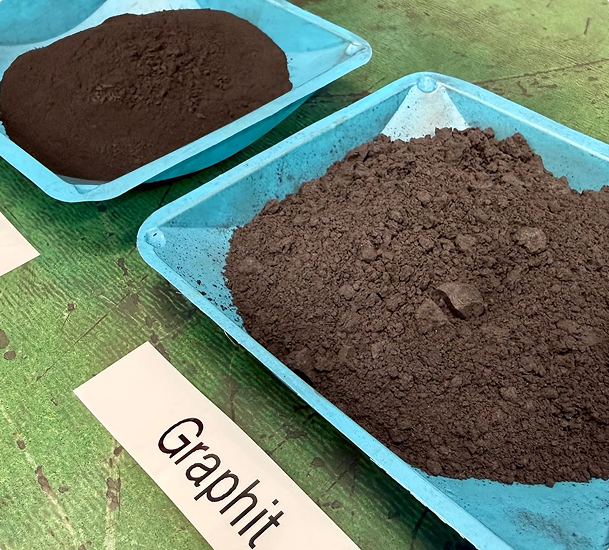
FIG. 01
Recovered graphite material samples
02 / THE APPROACH
From waste to new batteries.
GRAPHiREC covers the complete process from waste material to new battery prototypes
01
Collect
Battery-related waste materials are collected and characterised.
02
Recover
Graphite is separated and recovered through mechanical and hydrometallurgical processes.
03
Purify
The recovered graphite is purified and post-processed.
04
Evaluate
Its physical, chemical and electrochemical properties are evaluated.
05
Blend
The recycled graphite is blended with commercial graphite.
06
Validate
The material is tested in new lithium-ion and alkaline battery prototypes.
07
Assess impact
The environmental and economic performance of the processes is assessed.
TWO GRAPHITE-RECYCLING ROUTES
Different waste streams.
One shared objective.
Both pilot routes aim for more than 90% graphite recovery, with purity targets tailored to the battery technology.
ROUTE 01
Lithium-ion battery
manufacturing scraps
Led by ORIM S.p.A., this pilot combines mechanical separation and hydrometallurgical treatment, followed by purification and material characterisation.
>90%
recovery target
≥99.95%
purity target
ROUTE 02
Exhausted alkaline battery
black mass
Led by SIMA S.r.l., this pilot separates graphite from spent alkaline battery black mass for characterisation and reuse in new alkaline batteries.
>90%
recovery target
≥99.5%
purity target
THE NEXT STEP
Recycled material, validated
performance.
Recovering graphite is only the first part of the process. GRAPHiREC will also demonstrate whether recycled graphite can meet the technical requirements of battery manufacturers. The recovered materials will undergo physical, chemical and electrochemical characterisation. Where necessary, additional thermal treatment and surface modification will improve their performance.
The project aims to replace up to 30% of commercial natural graphite in selected applications.
03 / PROJECT OBJECTIVES
Building a circular
battery value chain.
GRAPHiREC aims to demonstrate not only technical feasibility, but also the environmental and economic potential for industrial adoption.
630t
GRAPHiREC aims to recover approximately 630 tonnes of graphite
~20%
And achieve an estimated reduction of around 20% in the CO₂ emissions associated with the corresponding production of graphite from primary sources
01
Resource resilience
Reduce demand for imported graphite and improve security of European battery-material supply.
02
Environmental benefit
Reduce waste and assess potential emissions, energy and water savings through life-cycle analysis.
03
Market readiness
Support new business models, replication opportunities, investment and adoption of recycled graphite.
Explore the full project objectives
establish two pilot plants for graphite recovery;
recover more than 90% of graphite from the selected waste streams;
achieve the purity required for battery applications;
validate recycled graphite in lithium-ion and alkaline battery prototypes;
demonstrate the environmental and economic viability of graphite recycling;
reduce waste, energy use, water consumption and greenhouse-gas emissions;
support the future commercial use of recycled graphite;
develop business and replication models for the recycling processes;
provide evidence that can inform European policy and investment decisions;
increase awareness of graphite recycling and its contribution to the circular economy.
EUROPEAN COLLABORATION
A shared European effort.
Through the EU LIFE Programme, GRAPHiREC connects research, industrial innovation and the circular economy to strengthen Europe’s battery-material value chain.
8 PARTNERS · 4 COUNTRIES · 1 SHARED MISSION
04 / THE CONSORTIUM
Expertise across the whole chain.
Eight partners from Italy, Germany, Sweden and Belgium connect waste treatment, advanced materials, battery manufacturing and European industry engagement.
Collaboration across the European battery recycling ecosystem
Leads communication, dissemination and stakeholder engagement; contributes to market deployment.
05 / PROJECT UPDATES
Progress &
latest news.
Follow development of the two recycling routes, research milestones and collaboration across the consortium.
PROJECT SNAPSHOT · 2 NOVEMBER 2026
Two industrial pilot routes are moving
forward.
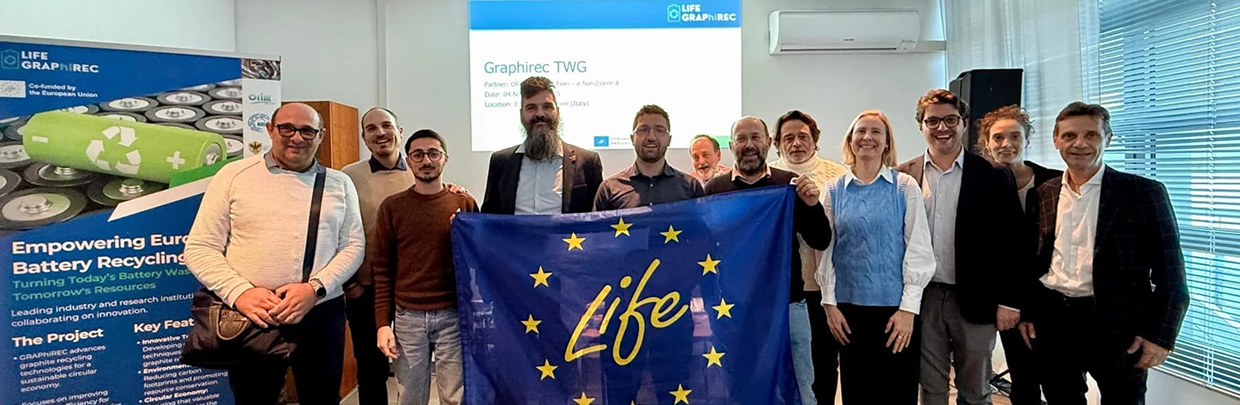
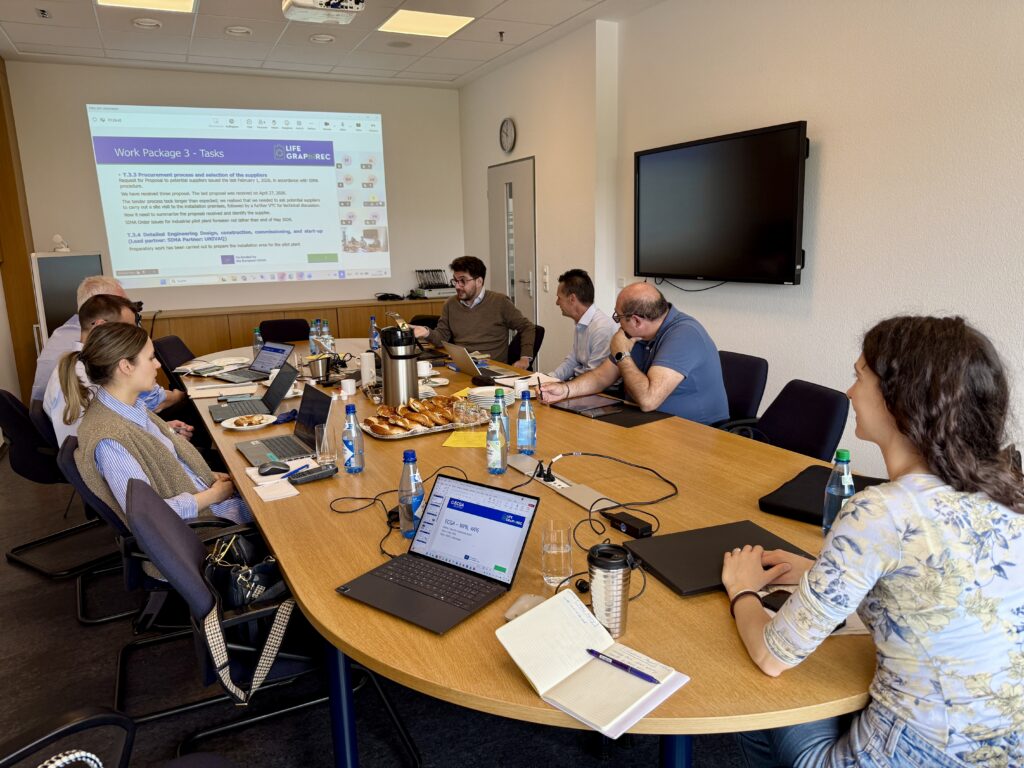
At the tenth GRAPHiREC Technical Working Group meeting, held online on 2 November 2026, the project partners reviewed progress across the work packages and the activities planned for the next project period.
ORIM is advancing the construction of the pilot plant for recovering graphite from lithium-ion battery manufacturing scraps. Engineering, equipment procurement and preparatory activities for pilot-scale operation are continuing.
SIMA has commissioned the grinding and separation machinery for the alkaline battery route and produced an initial batch of 25 kg of alkaline battery black mass. A 10 kg batch was transferred to the University of L’Aquila for purification and characterisation. Detailed engineering of the pilot plant is continuing.
The University of L’Aquila has received material from both recycling routes and is carrying out purification, process optimisation and material characterisation activities.
The University of Camerino has completed initial electrochemical characterisation of graphite processed and coated by Talga. The initial results showed encouraging material performance, and further samples will be assessed as they become available.
Talga’s activities relating to the thermal treatment, coating and post-processing of recovered graphite are progressing according to schedule.
Work is also continuing on environmental impact assessment, life-cycle assessment, life-cycle costing, circularity, market analysis and the future commercial application of recycled graphite.
The next project stages will focus on completing the pilot plants, producing larger quantities of recovered graphite, validating the material in battery applications and assessing the environmental and economic performance of the two recycling routes.
Read more progress details
News & project highlights
November 2026
Technical Working Group reviews project progress
The GRAPHiREC consortium held its tenth Technical Working Group meeting to review progress across the project’s work packages. Partners discussed the development of the two pilot recycling routes, the purification
Read more
October 2026
GRAPHiREC research receives Best Poster Presentation Award
Scientific work connected with GRAPHiREC received the Best Poster Presentation Award at the TUMA 2026 congress in Urbino, Italy. The awarded poster, entitled “Towards Circular Graphite for Lithium-Ion Batteries: Chemical
Read more
September 2026
GRAPHiREC included in the European Commission’s Innovation Radar
GRAPHiREC was included in the European Commission’s Innovation Radar, recognising the innovation potential of the project and its approach to recovering graphite from battery-related waste for reuse in new batteries.
Project 101147368 – LIFE23-ENV-IT-LIFE GRAPHiREC. Co-funded by the European Union. Views and opinions expressed are, however, those of the author or authors only and do not necessarily reflect those of the European Union or the European Climate, Infrastructure and Environment Executive Agency. Neither the European Union nor the granting authority can be held responsible for them.